- Home
- About Us
- Shop
- Card Personalization
Smart Card Printer
Card & Consumables
Card Softwares
- RFID & IOT
- Other Services
- Contact Us

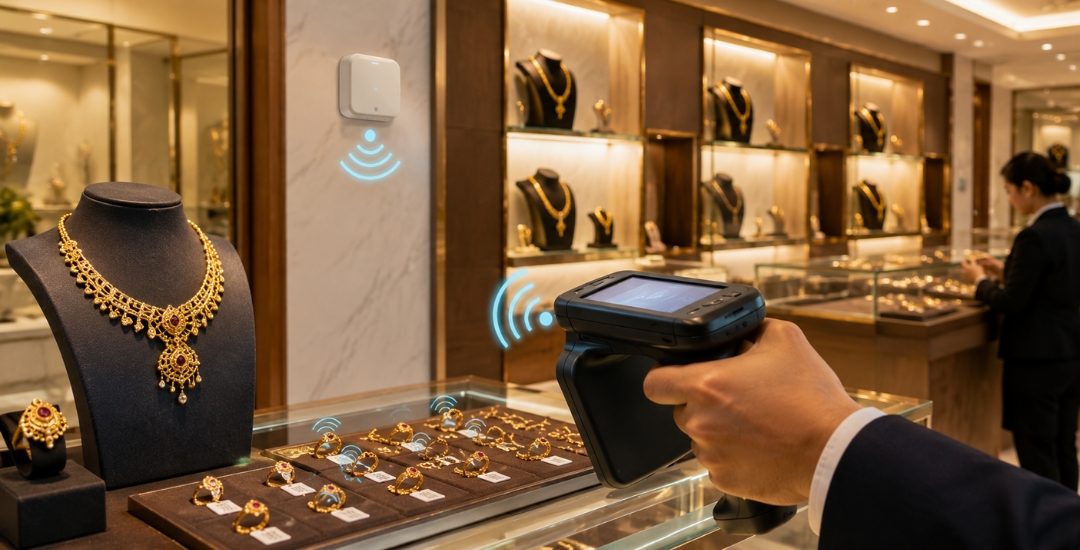
RFID jewellery inventory management India transforms how retailers, manufacturers, and wholesalers manage high-value gold, diamond, and precious stone inventory requiring constant security vigilance, accurate tracking, and efficient customer service. India’s position as the world’s largest consumer of gold jewellery—importing over 800 tonnes annually valued at approximately $40 billion—creates a massive market where inventory control directly impacts profitability and security. A single jewellery store maintaining inventory worth ₹5-20 crores faces daily challenges tracking thousands of individual pieces, preventing theft, reconciling stock during audits, and providing seamless customer browsing experiences without compromising security.
The traditional methods of jewellery inventory management—manual counting, physical inspection, and paper-based tracking—prove woefully inadequate for modern retail operations. Stock reconciliation requiring complete store shutdowns for 2-3 days every month disrupts sales while consuming enormous labor hours. Even then, discrepancies between physical counts and recorded inventory plague most jewellers, with variances of 1-3% considered “acceptable” despite representing lakhs of rupees in missing value. Theft both external (robbery, shoplifting) and internal (employee pilferage) causes significant losses that manual security measures struggle to prevent. Gold tracking RFID jewellery stores eliminates these problems through automated, real-time inventory visibility combined with integrated security systems.
The insurance and regulatory compliance dimensions add urgency to RFID adoption. Insurance companies covering jewellery inventory increasingly require robust tracking systems as conditions for coverage or premium reductions. Hallmark regulations mandating identification and tracking of gold purity create documentation requirements that manual systems cannot efficiently satisfy. Customer expectations for modern retail experiences—including quick service, accurate product information, and seamless checkout—pressure jewellers to adopt technologies delivering both operational efficiency and enhanced customer engagement. Diamond inventory RFID solution addresses all these needs through comprehensive tracking from wholesale purchases through retail sales.
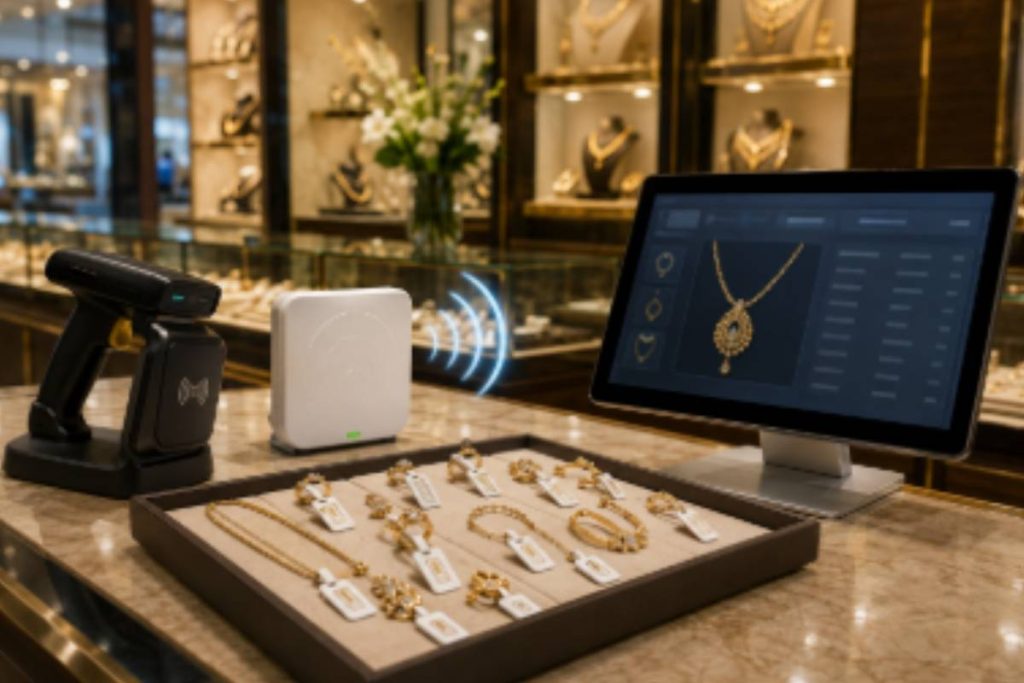
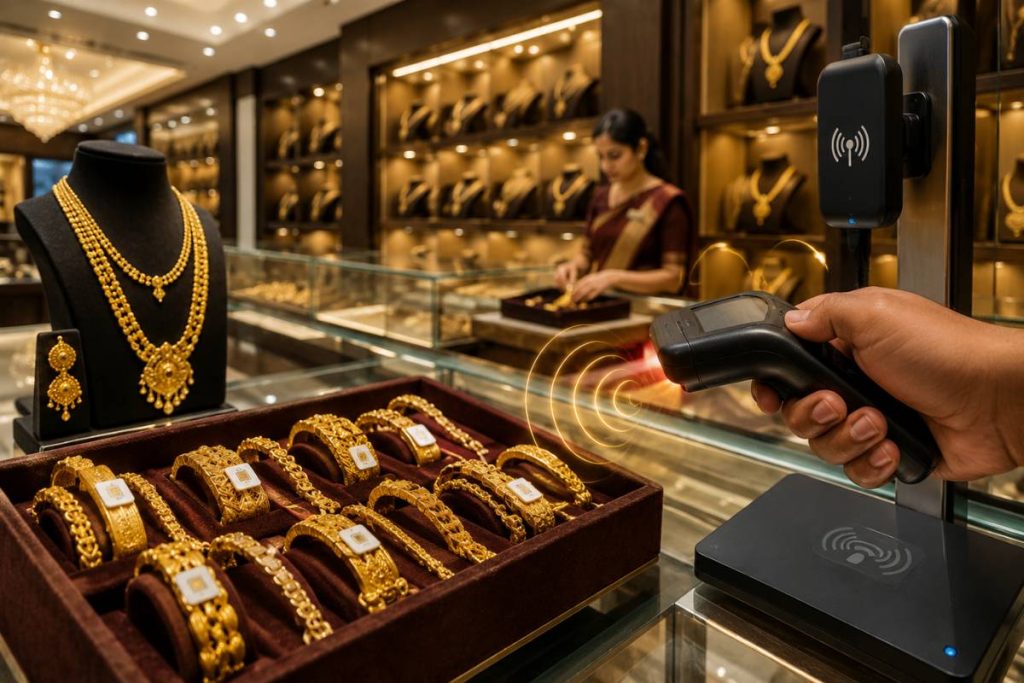
RFID jewellery inventory management India employs specialized passive HF RFID tags—operating at 13.56 MHz frequency—attached to individual jewellery pieces or embedded in display trays. HF technology proves superior to UHF for jewellery applications due to its immunity to metal interference (critical when tagging gold and silver items) and shorter read ranges providing precise location identification within display cases. Each tag encodes a unique identifier linking to backend systems storing detailed product information: item description, metal type and purity, gemstone specifications, weight, purchase cost, retail price, supplier details, and current location.
The technology infrastructure combines multiple components creating comprehensive tracking and security. Display cases equipped with RFID reader antennas continuously monitor tagged items, detecting when pieces move between cases or leave displays. When a customer shows interest in a particular necklace, the sales associate removes it from the display case; the RFID system automatically logs the removal, associates it with that employee’s ID badge (also RFID-tagged), and tracks the item’s location as it moves to the sales counter for closer customer examination.
Point-of-sale integration ensures automatic inventory updates during transactions. When a customer purchases an item, the POS system’s RFID reader verifies the sold item matches the transaction record, updates inventory databases reflecting the sale, and deactivates the item’s security monitoring. This automated process eliminates manual inventory adjustments prone to errors while ensuring security systems don’t trigger false alarms when legitimate purchasers exit with bought jewellery.
Vault and storage area monitoring provides security for high-value inventory not on display. RFID-enabled vault doors and secure cabinets track items entering and exiting restricted areas, creating audit trails showing exactly when items moved and which employees accessed them. For retail jewellery automation India, this capability proves invaluable during shift changes, employee rotations, and management transitions—times when internal theft risks peak due to unclear accountability.
The mobile inventory management capabilities transform stock reconciliation from multi-day ordeals into minutes-long exercises. Handheld RFID readers enable staff to conduct complete store inventory scans without removing items from displays or disrupting customer browsing. Walking through the store while scanning creates real-time inventory counts comparing physical presence against database records, immediately identifying discrepancies requiring investigation. This frequent, low-effort inventory capability—weekly or even daily if desired—maintains constant accuracy rather than discovering problems only during monthly shutdowns.
Jewellery theft represents an existential threat to retailers, with losses from robbery, grab-and-run incidents, and sophisticated theft schemes costing the industry hundreds of crores annually. Gold tracking RFID jewellery stores transforms security from reactive alarms to proactive monitoring and prevention. The system doesn’t just detect theft after it occurs—it prevents many theft attempts through visible deterrence and enables rapid response when incidents happen.
Display case security integration creates the first line of defense. RFID readers monitoring cases detect unauthorized removals—items leaving displays without proper employee badge authentication trigger immediate silent alarms to security personnel while cameras focus on the relevant display area. This real-time detection enables intervention before thieves leave premises. For organized theft gangs sending multiple members to distract staff while accomplices grab inventory, RFID alerts security to suspicious activity patterns—multiple items removed from different cases simultaneously, unusual movement speeds, or items moving toward exits rather than sales counters.
Employee accountability mechanisms address internal theft, which industry estimates suggest accounts for 30-40% of jewellery losses. When employees handle inventory, their ID badges associate with item movements—Salesperson A removed Necklace X from Display 5 at 2:47 PM, brought it to Sales Counter 2, and returned it to storage at 3:15 PM. This detailed tracking doesn’t assume theft but creates accountability making internal theft difficult. Discrepancies between employee-associated movements and actual item locations trigger investigations. The mere knowledge that all inventory handling is automatically tracked deters opportunistic theft by creating unacceptable detection risks.
Jewelry theft prevention RFID extends beyond store premises to transportation security. When jewellers transfer inventory between stores, exhibitions, or wholesale markets, tagged items traveling with GPS-enabled RFID readers create real-time location tracking. If transport vehicles deviate from expected routes or items are removed during transit, alerts enable immediate response. This tracking proves particularly valuable for high-value items worth lakhs or crores—individual diamond pieces, elaborate bridal sets, antique jewellery—where theft during transport represents catastrophic losses.
The insurance benefits of comprehensive tracking manifest in multiple ways. Insurers covering jewellery inventory offer premium discounts—typically 15-30%—for stores implementing RFID security systems, recognizing reduced theft risks. Claims processing accelerates when RFID records document exactly what was stolen, when theft occurred, and that proper security protocols were followed. Some insurers now mandate RFID for stores maintaining inventory above certain value thresholds, making implementation necessary for coverage rather than optional.
Diamond and precious stone inventory presents unique challenges beyond gold jewellery. Individual diamonds worth lakhs or crores require item-level tracking with zero tolerance for losses. Diamond inventory RFID solution addresses this through specialized tagging strategies and enhanced security protocols matching the extraordinary value of tracked items.
The tagging approach for loose diamonds differs from finished jewellery. Since attaching tags directly to small loose stones proves impractical, diamond traders use RFID-tagged containers or packets holding individual stones or matched sets. Each tag encodes detailed diamond specifications—carat weight, cut grade, color rating, clarity grade, certification numbers from gemological laboratories—enabling precise identification without requiring physical inspection. This electronic identification accelerates transactions; wholesalers and retailers verify diamond details by scanning tags rather than examining stones under loupes, reducing handling that risks damage or loss.
Certification integration creates powerful authentication capabilities. Major diamond certification laboratories increasingly issue certificates with RFID chips encoding the stone’s unique characteristics and certificate number. Diamond inventory RFID solution integrates these certified tags with inventory systems, creating tamper-evident records proving stone authenticity. When customers purchasing expensive diamonds demand proof of certification, retailers scan tags displaying complete gemological reports from trusted certification authorities—far more convincing than paper certificates prone to forgery.
The consignment tracking features prove essential for diamond trade’s complex ownership structures. Diamond retailers often hold inventory on consignment from wholesalers or manufacturers who retain ownership until retail sale. RFID tags encoding ownership details enable retailers to manage mixed inventory—their own stones plus multiple consignors’ merchandise—with perfect separation. When conducting inventory reconciliations, the system automatically generates consignor-specific reports showing exactly which stones from each supplier remain in inventory, were sold (with sales details), or require return.
High-value item monitoring provides specialized security for exceptional pieces. Diamonds worth ₹10 lakhs or more—rare colored diamonds, large D-Flawless stones, antique pieces—receive enhanced tracking including real-time location monitoring within stores, tamper-evident packaging, and automatic alerts if items move without proper authorization. For pieces worth crores, some retailers implement video analytics integration where RFID item removal triggers automatic video recording from multiple angles creating visual documentation of all handling.
Modern jewelry theft prevention RFID extends beyond simple alarms to create integrated security ecosystems combining RFID tracking, video surveillance, access control, and alarm systems into coordinated platforms. This integration multiplies effectiveness—each technology component provides data enriching others, creating comprehensive security impossible with standalone systems.
The video surveillance integration illustrates this synergy. When RFID detects unusual item movements—multiple pieces removed from displays simultaneously, items moving toward exits without POS transactions, vault items accessed outside normal hours—the system automatically cues video management platforms to start recording relevant camera feeds and sends alerts to security personnel with live video links. Security teams don’t just receive abstract “Item 347 removed from Display 12” alerts; they get that alert plus instant video showing exactly what’s happening, enabling informed rapid response distinguishing genuine theft from legitimate customer browsing.
Access control integration creates secure zones within retail environments. High-value inventory rooms, vault areas, and management offices use RFID access badges controlling entry. The system tracks not just who entered restricted areas but cross-references with inventory movements—if Employee X accesses the vault and Item Y subsequently shows inventory discrepancy, audit trails provide investigative starting points. This accountability extends to customers; some high-end jewellers use RFID visitor badges tracking customer movements through stores, creating behavior analytics showing browsing patterns and identifying unusual activity warranting closer attention.
Alarm system coordination ensures appropriate responses to different security events. Not all RFID alerts require identical responses—items removed from displays during business hours with proper employee authentication trigger different protocols than identical removals during closed hours or without authentication. Retail jewellery automation India platforms integrate with burglar alarms, creating context-aware security responses: after-hours item movements trigger audible alarms and police notifications, while daytime movements without employee badge authentication trigger silent alerts to floor managers enabling discrete investigation without alarming customers.
The loss prevention analytics capabilities transform security from reactive to proactive. RFID systems accumulate data revealing patterns invisible to traditional security. Analysis might show certain display cases experience higher-than-normal item removals without corresponding sales, suggesting either customer browsing inefficiency or potential employee manipulation. Certain time periods might correlate with inventory discrepancies, focusing investigation efforts. These insights enable management to address security vulnerabilities before major losses occur rather than discovering problems only after theft incidents.
Beyond security and inventory accuracy, retail jewellery automation India through RFID enhances customer experiences and operational efficiency in ways directly impacting sales and profitability. The technology enables modern retail experiences that tech-savvy customers increasingly expect while reducing operational friction that previously consumed staff time.
Interactive displays transform customer browsing from passive viewing to engaging exploration. RFID-enabled displays detect when customers show interest in particular pieces—lifting items for closer examination, spending extended time viewing specific displays—and automatically present relevant information on nearby screens: metal purity, gemstone details, design inspiration, price, and available customization options. This self-service information access empowers customers to explore independently without requiring constant staff attention, freeing associates to focus on serious buyers rather than casual browsers.
The virtual try-on integration leverages RFID item identification with augmented reality platforms. When customers pick up tagged jewellery pieces, the system identifies items and enables virtual try-on experiences using tablets or smart mirrors—seeing how necklaces or earrings look without physical wearing, trying combinations of pieces not physically co-located in displays, or visualizing customizations before committing to purchases. This technology particularly benefits younger customers comfortable with digital experiences while accelerating decision-making by enabling rapid comparison of multiple options.
Checkout acceleration eliminates the tedious multi-step process traditional jewellery purchases require. Instead of sales associates manually recording item details, verifying inventory records, and updating systems, RFID-integrated POS simply scans purchased items auto-populating transaction records with complete product information, pricing, and tax calculations. This automation reduces checkout time from 10-15 minutes to 2-3 minutes—significant when every minute of customer wait time increases abandonment risks for high-value purchases where buyers often experience last-minute hesitation.
The omnichannel integration enables jewellers to compete with e-commerce through buy-online-pickup-in-store and ship-from-store capabilities. RFID provides real-time inventory visibility across multiple locations, allowing online shoppers to verify item availability and reserve specific pieces for store pickup. When customers purchase online, the system guides store staff to exact item locations enabling immediate order fulfillment. For items requiring sizing, customization, or gift wrapping, RFID tracking ensures proper pieces receive requested services before customer pickup.
Personalized service capabilities emerge from RFID-enabled customer relationship management. When returning customers enter stores, their purchase histories (tracked through previous RFID transactions) enable personalized recommendations—showing new arrivals matching past preferences, anniversary or birthday reminders suggesting gift purchases, or loyalty program benefits based on cumulative spending. This personalization builds relationships driving repeat business critical in luxury retail where customer lifetime value far exceeds individual transaction values.
Successful RFID jewellery inventory management India deployment requires addressing unique challenges of high-value inventory environments. Tag selection proves critical—jewellers need tags small enough to attach discretely to delicate pieces without affecting aesthetics. Modern jewellery tags resemble quality control labels, measuring just 15x8mm, attachable to existing price tags or security tags jewellers already use. For loose stones and small items, RFID-enabled trays or containers provide tracking without item-level tagging.
The phased implementation approach minimizes disruption and manages investment. Starting with high-value inventory categories—diamond jewellery, platinum items, designer collections—proves costs through tracking items where losses have biggest financial impact. Success with initial categories builds organizational support for expanding RFID across entire inventory. This phased approach also allows staff to develop operational expertise before enterprise-wide deployment.
Software integration with existing systems—POS platforms, accounting software, customer relationship management, website inventory displays—determines whether RFID delivers promised benefits. The greatest value emerges when RFID data automatically updates all connected systems rather than existing as isolated information requiring manual transfer.
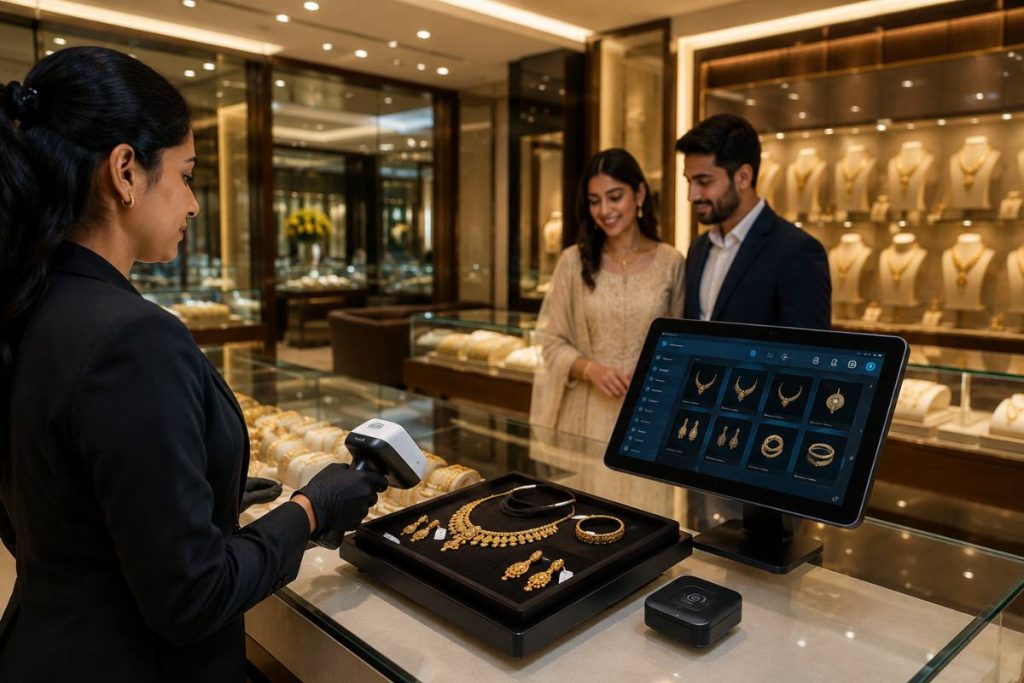
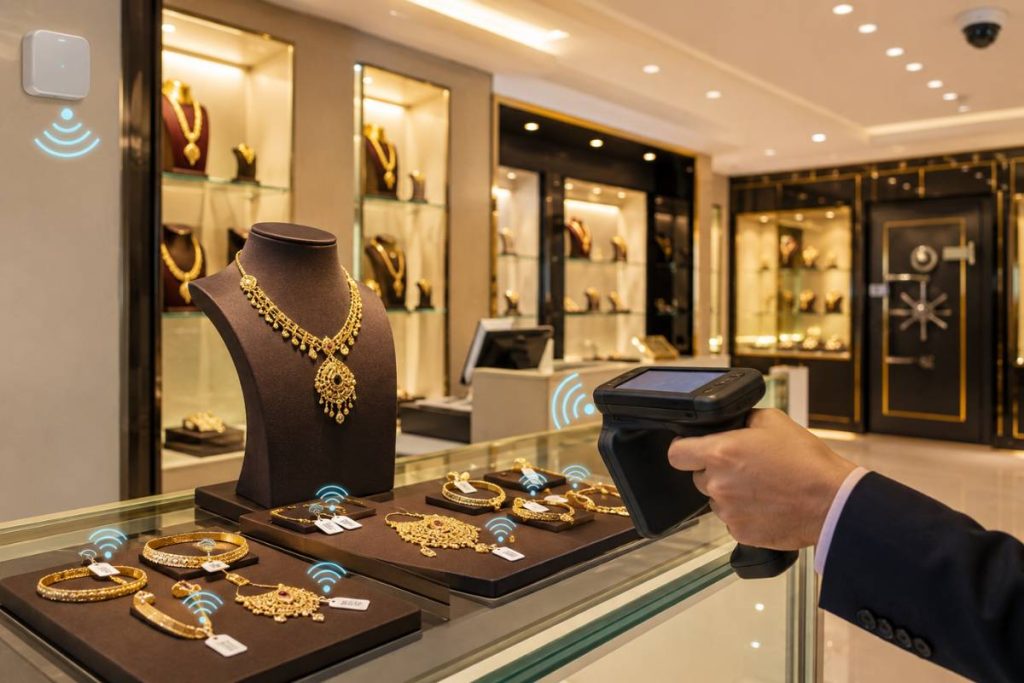
India’s jewellery retail industry handles high-value gold, diamond, and precious jewellery inventory where even small tracking errors can lead to major financial losses and operational delays.
Ecartes Technology delivers advanced RFID jewellery inventory management solutions combining RFID tags, smart readers, handheld devices, and real-time analytics platforms. With 28+ years of RFID expertise and trusted industry experience, we help jewellery businesses improve inventory accuracy, reduce theft risks, and streamline retail operations.
RFID jewellery inventory management India prevents theft through real-time tracking showing exactly which items moved, when, and by whom—creating accountability impossible with traditional systems. Display case readers detect unauthorized removals triggering immediate alerts before thieves exit premises. Employee badge integration associates all item handling with specific staff, deterring internal theft. Integration with video surveillance automatically records incidents from multiple angles. Traditional security relies on after-the-fact detection; RFID enables prevention through continuous monitoring and immediate response.
No, modern jewellery RFID tags attach externally like existing price tags and contain no components that damage precious metals or gemstones. Tags use adhesive safe for direct gold contact or attach to existing hang tags avoiding direct jewellery contact. The HF frequency used for gold tracking RFID jewellery stores doesn’t generate heat or magnetic fields affecting metals or stones. Tags are smaller than traditional price labels (15x8mm typical size), maintaining aesthetic appearance. For loose diamonds, tags attach to containers rather than stones, eliminating any contact risk.
Jewelry theft prevention RFID typically delivers 8-12 month ROI for retailers with ₹5+ crore inventory. Primary benefits include: 60-80% reduction in inventory losses (theft, shrinkage, misplacement), 70-80% reduction in stock reconciliation time (from days to hours), 15-30% insurance premium reductions, improved customer service enabling 10-15% sales increases, and accurate inventory enabling better purchasing decisions. A jeweller investing ₹8-12 lakhs in RFID typically saves ₹10-15 lakhs annually in loss prevention alone, before considering operational efficiency and sales improvements.
Diamond inventory RFID solution verifies authenticity by integrating certification laboratory data into tag encoding. Tags on diamond items or containers encode gemological certificate numbers, characteristics (carat, cut, color, clarity), and certification authority. Scanning tags displays this verified information instantly. Advanced implementations integrate directly with gemological laboratory databases, enabling real-time verification that certificate numbers are genuine and match encoded specifications. This prevents fraudulent certificates and provides customers with independently verifiable proof of diamond quality from trusted certification authorities.
Yes, retail jewellery automation India through RFID excels at consignment tracking. Tags encode ownership information identifying which items belong to the retailer versus specific consignors. The system automatically generates consignor-specific inventory reports showing which pieces remain unsold, were sold (with sale dates and prices), or require return. This automated separation eliminates manual sorting errors common when retailers manage mixed inventory from multiple suppliers. Consignment accounting becomes automatic—systems calculate commissions based on actual sales tracked through RFID transactions.
RFID reduces complete store inventory audits from 2-3 days to 2-3 hours. Staff using handheld readers walk through stores scanning all displays and storage areas; the system compares scanned items against database records identifying discrepancies. This speed enables weekly or even daily audits instead of monthly shutdowns, maintaining constant inventory accuracy. Quick audits catch discrepancies early when investigation can determine causes, versus discovering losses months later when evidence trails have disappeared. Fast, frequent auditing also satisfies insurance requirements and improves financial reporting accuracy.

Content writer at Ecartes Technology specializing in RFID solutions, industrial automation, and smart manufacturing. I create research-driven, SEO-focused content that educates businesses and supports digital transformation across India’s industrial sectors.
Enhance efficiency, accuracy, and security with our cutting-edge RFID solutions. From inventory management to access control, we provide customized RFID systems tailored to your needs. Optimize operations and reduce costs—get started today!
© Powered by E-Cartes Technology Pvt. Ltd.
Design & Developed By 


