- Home
- About Us
- Shop
- Card Personalization
Smart Card Printer
Card & Consumables
Card Softwares
- RFID & IOT
- Other Services
- Contact Us

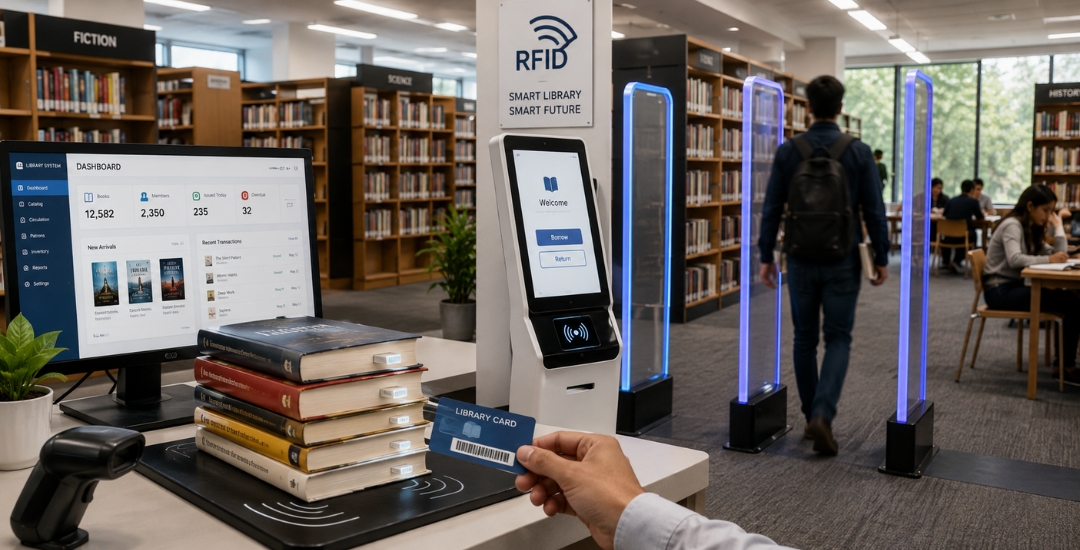
RFID library management system India 2026 modernizes how academic libraries, public libraries, and specialized collections manage millions of books, journals, and media resources serving patrons who expect Amazon-like convenience from physical library experiences. India’s library infrastructure—spanning prestigious university systems, government public library networks, research institutions, and corporate knowledge centers—maintains collective holdings exceeding 500 million volumes. Managing these vast collections using traditional barcode systems creates operational bottlenecks: slow checkout requiring staff intervention for every transaction, time-consuming inventory audits demanding complete shelf-by-shelf physical verification, and security systems providing minimal theft deterrence. Libraries modernizing through book tracking RFID libraries India transform these pain points into seamless automated workflows.
The student experience in university libraries illustrates typical frustrations RFID eliminates. During exam periods, academic libraries experience surge demand with hundreds of students simultaneously checking out materials. Traditional barcode checkout requires staff to manually scan each item—a process taking 1-2 minutes per transaction when including patron ID verification, due date stamping, and security gate deactivation. This creates long queues during peak hours, deterring library use and frustrating students pressed for study time. Self-checkout library RFID enables students to independently process checkouts in 15-20 seconds, eliminating queues while freeing librarians to provide research assistance rather than serving as transaction processors.
The operational efficiency gains extend far beyond checkout speed. Library staff conducting annual inventory verification traditionally spend weeks pulling books from shelves, scanning barcodes, and reconciling physical holdings against catalog records. University library automation RFID compresses this multi-week ordeal into hours-long exercises using mobile readers that scan entire shelves simultaneously without removing books. This dramatic time savings allows libraries to conduct frequent inventory audits—monthly or quarterly rather than annually—maintaining accurate collection data for patron searching while quickly identifying missing materials requiring replacement or investigation. Smart library solution India implementations delivering these benefits are becoming essential infrastructure rather than luxury technology.
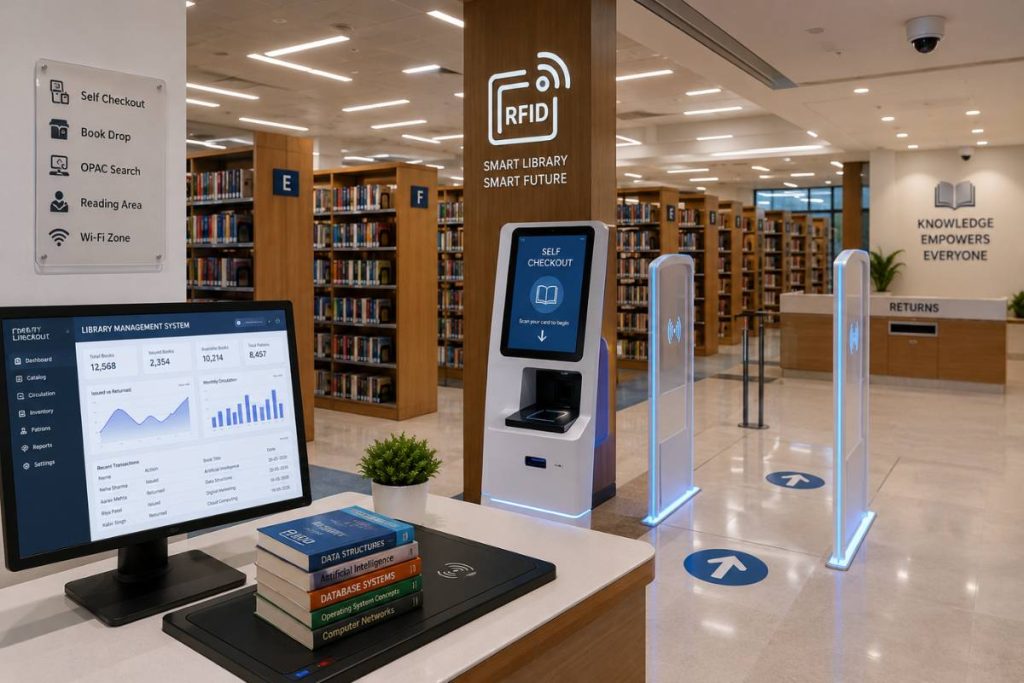
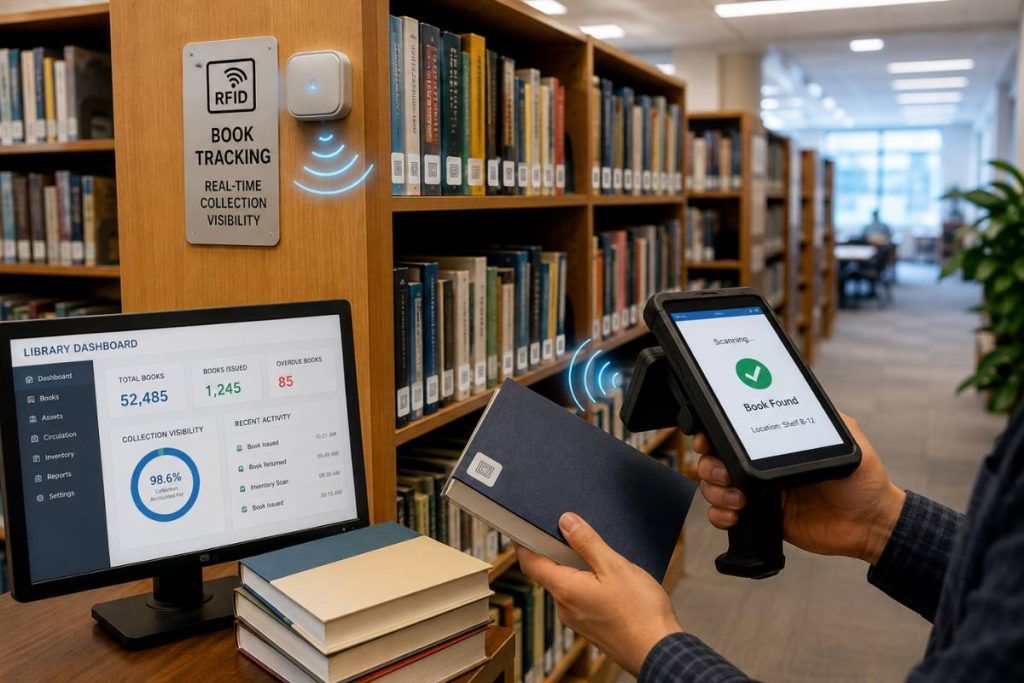
RFID library management system India 2026 employs passive HF RFID tags (operating at 13.56 MHz) adhered inside book covers or media cases, combined with various reader types handling different library functions. The HF frequency provides optimal performance for library environments—immunity to interference from metal shelving, moisture in books, and dense paper stacks that challenge UHF signals. Each tag stores a unique identifier linking to the library’s integrated library system (ILS) database containing all bibliographic information, circulation history, and current availability status.
The technology infrastructure encompasses multiple specialized components. Staff workstations equipped with RFID pads enable assisted checkout and return processing—librarians place books on reader pads that instantly identify all items for batch processing. Unlike barcode systems requiring individual scanning of each item, RFID pads read stacks of books simultaneously, dramatically accelerating staff-mediated transactions when patrons check out armloads of research materials or return multiple items. This bulk processing capability proves particularly valuable during high-volume return periods when students bring back dozens of books after completing term papers.
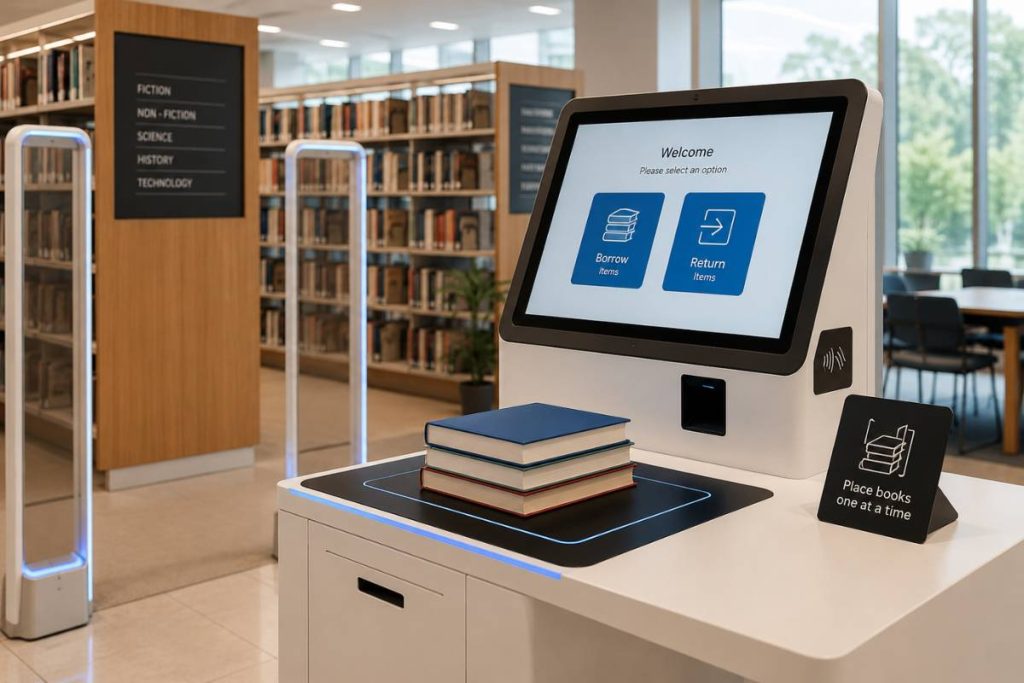
Self-service kiosks transform patron experiences by enabling independent checkout without staff assistance. These standalone units combining RFID readers, user authentication (via library card scanning or biometric verification), and touch-screen interfaces guide patrons through simple checkout workflows: authenticate identity, place books on the RFID reader platform, confirm checkout on screen, collect receipt. The entire process completes in 15-30 seconds, processing 5-10 books simultaneously. Libraries deploying self-checkout kiosks typically see 60-70% of transactions shift from staff-mediated to self-service, significantly reducing circulation desk staffing requirements while improving service hours—self-service operates 24/7 in libraries with extended access, versus staff desks limited to business hours.
Return systems automate the most labor-intensive circulation function. Book drops equipped with RFID readers automatically check in returned materials, update catalog availability, and sort items by classification or destination (main stacks, special collections, interlibrary loan return, damaged items requiring repair). Advanced return systems use conveyor belts and automated diverters routing books to appropriate bins—Reference books to Cart A, Children’s literature to Cart B, damaged items to manual inspection area. This automation eliminates hours of manual sorting while enabling continuous return processing in unstaffed book drops operating evenings, weekends, and holidays.
Security gates at library exits provide anti-theft protection integrated with circulation systems. Unlike standalone EM (Electro-Magnetic) security systems using dummy security strips, RFID gates verify item checkout status from actual circulation records. When patrons exit carrying properly checked-out materials, gates remain silent. Unchecked items trigger visible and audible alarms while capturing security footage from integrated cameras. This intelligent security prevents false alarms from checked-out materials while providing definitive evidence during actual theft incidents—the system knows exactly which book triggered the alarm and can display its cover image and catalog information to security staff.
Academic and research libraries managing hundreds of thousands of volumes face perpetual challenges knowing their exact holdings and locations. Book tracking RFID libraries India transforms collection management from periodic snapshot inventories to continuous real-time tracking enabling patron self-service discovery tools impossible with barcode systems.
The mobile inventory scanning capability revolutionizes collection verification. Library staff using RFID-enabled handheld devices or specially designed inventory carts walk through stack areas; the readers scan all books on shelves within range—typically 30-50 cm—without requiring physical contact. A single staff member can verify an entire floor’s holdings in hours versus the weeks traditional barcode inventory demands. The mobile readers identify not just which books are present but also detect mis-shelved items—books filed in wrong locations making them undiscoverable to browsing patrons despite being physically available.
The shelf-reading applications prevent the common problem where books get returned to incorrect locations during reshelving. As staff push carts loaded with returned books through stacks, RFID readers continuously scan shelves comparing shelf order against classification system requirements. When books are out of sequence, the device provides visual and audio alerts enabling immediate correction rather than discovering mis-shelving months later during full inventory audits. This continuous shelf verification maintains browsable collections where patrons confidently find materials in expected locations rather than encountering frustrating gaps where catalog records indicate presence but physical browsing reveals absence.
Book location tracking provides patron services previously impossible in large libraries. When patrons search library catalogs for specific titles, RFID-integrated systems display not just “available” status but precise location data: “Shelf 47, Row G, 3rd floor, East Wing—last scanned 2 hours ago.” This granular location information eliminates futile searches for books incorrectly reshelved or in-use on study tables. Some advanced implementations provide mobile app integration with indoor positioning guiding patrons directly to specific shelf locations—library navigation becoming as easy as following Google Maps directions to street addresses.
The weeding and deselection processes benefit from RFID usage analytics. Library collections require periodic evaluation removing outdated, damaged, or never-used materials to free shelf space for new acquisitions. RFID systems track individual item circulation histories—how many times each book checked out, when last borrowed, whether patrons frequently browse but decline to checkout (measured through shelf disturbance patterns). This data-driven deselection proves far more effective than arbitrary age-based rules (remove books published before year X) or subjective judgment. Materials demonstrating zero usage over extended periods become removal candidates while frequently browsed items remain regardless of publication date.
The student expectations shaped by commercial retail experiences—Amazon’s one-click purchasing, grocery store self-checkout, smartphone commerce—create pressure on libraries to provide equivalent convenience. Self-checkout library RFID delivers this modern service experience while reducing operational costs and extending access hours beyond traditional staffed operations.
The transaction speed improvements directly impact library usage, particularly during exam periods when students have minimal time between classes. Traditional checkout requiring 1-2 minutes per transaction (locate staff, wait in queue, hand over books and ID, receive due date stamp) versus 15-20 second self-service creates different usage patterns. Students with tight schedules skip library visits when queues appear long, reducing collection utility. Self-checkout eliminates queues even during peak periods—six self-service kiosks provide transaction capacity equivalent to having six staff members dedicated to circulation, impossible under typical library budgets.
The privacy benefits prove particularly important for academic and public libraries. Some patrons prefer not disclosing reading selections to staff—materials on sensitive health topics, political subjects, religious questions, or personal development. Self-checkout provides complete transaction privacy; patrons authenticate identity and process checkouts without staff awareness of borrowed materials. This privacy encourages usage of library resources addressing personal issues or controversial topics that patrons might avoid if requiring staff interaction. Privacy-conscious implementations even suppress screen displays showing book titles during self-checkout, presenting only generic “Item 1, Item 2” labels during processing.
Extended hours operations become economically viable through RFID automation. University libraries receive student demands for 24/7 access during exam periods but struggle affording continuous staffing. Self-service RFID infrastructure enables hybrid models: staffed service desks during daytime for research assistance and complex transactions, automated self-service evenings and nights for basic checkout/return. Security cameras and RFID-enabled access control (student ID cards unlocking library doors) provide adequate supervision for self-service periods. Some libraries operate completely self-service nights and weekends, reducing staffing costs 30-40% while improving student access.
The patron education requirements prove minimal for RFID self-service. Unlike complex library classification systems requiring expert knowledge, self-checkout kiosks use intuitive touchscreens with visual instructions guiding patrons step-by-step. First-time users complete transactions successfully with minimal assistance. Libraries typically install kiosks with staff monitoring nearby initially, then reduce supervision as patrons become comfortable—usually 2-3 weeks post-deployment. Multilingual interfaces support diverse patron populations; kiosks offering Hindi, English, and regional language options ensure accessibility across India’s linguistically diverse library users.
Academic libraries serve unique constituencies with specific needs differentiating them from public libraries. University library automation RFID addresses requirements spanning special collections protection, interlibrary loan coordination, reserve materials management, and research support that general library systems inadequately serve.
Special collections and rare materials require enhanced security and environmental monitoring. University libraries maintaining historically significant manuscripts, first editions, or institutional archives use RFID tags with tamper-evident features and environmental sensors. These specialized tags monitor temperature and humidity exposure—critical for preserving fragile materials—while preventing unauthorized removal from designated reading rooms. When rare materials leave climate-controlled environments or exit special collections areas without proper authorization, RFID systems trigger immediate alerts enabling intervention before irreplaceable resources suffer damage or theft.
The interlibrary loan workflows benefit enormously from automated tracking. Universities participating in resource-sharing consortiums regularly send and receive materials from partner institutions. RFID tags encoding ownership information enable automatic segregation of materials during returns—the system identifies books belonging to other institutions and routes them to interlibrary loan departments for return shipping rather than reshelving in local stacks. This automation prevents common errors where borrowed materials get incorrectly added to permanent collections, creating consortium disputes and replacement costs.
Reserve collections for high-demand course materials operate under special circulation rules—shortened loan periods (2-hour or overnight checkouts versus standard 2-week loans), restrictions preventing removal from library buildings, or controlled access requiring faculty approval. RFID systems enforce these complex rules automatically. Tags on reserve materials link to circulation policies specifying restrictions; self-checkout kiosks refuse completing transactions violating rules (attempting overnight loan of in-library-only reserve) while explaining constraints to patrons. This automated enforcement ensures equitable access to scarce course materials while reducing staff workload managing manual overrides.
Thesis and dissertation management represents another academic-specific application. University libraries maintaining student research archives use RFID for automated cataloging and retrieval of theses/dissertations. Students submit digital copies during graduation, triggering automated RFID tag generation encoding metadata (author, degree program, year, advisor, keywords). Physical copies receive tags enabling long-term tracking through archival storage, retrieval for reference requests, and digitization projects converting historical theses to electronic format.
Modern libraries increasingly blend physical and digital resources creating hybrid environments where patrons seamlessly transition between print books and e-resources. Smart library solution India implementations integrate RFID physical tracking with digital resource management, creating unified discovery and access platforms.
The catalog integration provides single-search interfaces spanning print and electronic holdings. When patrons search library catalogs, results display both physical books (with RFID-tracked location and availability data) and electronic alternatives (e-books, journal articles, databases). RFID real-time availability ensures search results accurately reflect current status—items shown as available truly sit on shelves rather than being misshelved or in-use in reading rooms. This accuracy prevents patron frustration from catalog records indicating availability that physical searches cannot confirm.
Mobile app integration transforms smartphones into library assistants. Patrons browse catalogs from anywhere, identify desired materials, and receive RFID-powered location guidance navigating to specific shelves. Upon arrival at shelf locations, apps display book cover images facilitating visual identification among similar spines. For checked-out materials, apps show due dates and enable renewals—all powered by RFID circulation records automatically syncing with mobile platforms. Some implementations support pickup notifications: search catalog, request items for hold, receive notification when materials shelf-ready for pickup at circulation desk.
The analytics capabilities provide library administrators with insights impossible from manual systems. RFID generates data revealing collection utilization patterns: which subject areas circulate most frequently, which materials browse heavily but rarely checkout, which sections patrons visit during different times/days. This intelligence drives evidence-based collection development—purchasing more materials in high-demand subjects, relocating popular collections to prominent library areas, weeding sections showing zero usage. Analytics also identify operational inefficiencies: reshelving bottlenecks where returned materials accumulate, underutilized seating areas, peak traffic periods requiring additional staffing.
The space utilization analytics increasingly important as libraries evolve from book repositories toward learning commons providing study space, technology access, and collaborative work areas. RFID sensors throughout libraries track occupancy patterns showing which areas fill quickly during exam periods, which study rooms remain underutilized, which times see peak demand. This data informs furniture reallocation, study room reservation systems, and building renovation plans expanding popular areas while repurposing underused spaces.
Indian libraries deploying RFID library management system India 2026 benefit from phased approaches managing costs while building organizational expertise. Starting with high-value collections—reference materials, special collections, or high-theft categories—proves ROI before enterprise-wide investment. Success with initial phases builds staff acceptance and patron familiarity before expanding system-wide.
Funding strategies vary by library type. University libraries leverage institutional technology budgets, government grants, or alumni donations. Public libraries access central/state government library development funds or public-private partnerships. Vendor financing options spread costs across 3-5 year periods, enabling implementation without large upfront capital requirements. The operational savings from reduced staffing needs and fewer material losses typically offset financing costs within 2-3 years.
Staff training determines adoption success. Librarians comfortable with traditional methods may resist technology perceived as threatening jobs or requiring technical skills. Effective training emphasizes professional development—RFID eliminates tedious clerical work allowing focus on research support, collection development, and patron services utilizing librarian expertise. Framing RFID as staff empowerment rather than replacement improves acceptance.
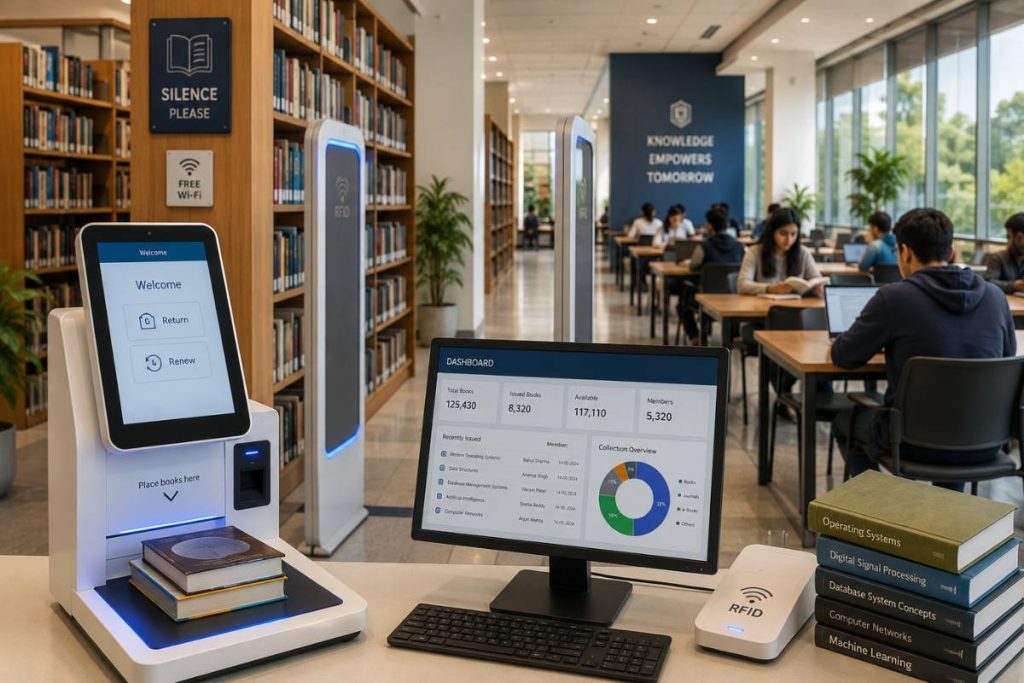
Protect Library Efficiency with RFID Library Management System India 2026
India’s academic, public, and institutional libraries manage millions of books, journals, and digital resources where slow circulation, misplaced books, and manual inventory audits create operational inefficiencies and poor user experiences.
Ecartes Technology delivers advanced RFID library management system India 2026 solutions combining RFID tags, self-checkout kiosks, handheld readers, anti-theft gates, and real-time library analytics platforms. With 28+ years of RFID expertise and trusted technology experience, we help libraries automate circulation, improve inventory accuracy, prevent book theft, and create smarter campus library environments.
RFID library management system India 2026 processes multiple items simultaneously versus barcode’s one-by-one scanning, reducing checkout time from 1-2 minutes to 15-20 seconds. Self-checkout library RFID kiosks read entire book stacks at once—patrons place 5-10 books on reader platform, authenticate identity, confirm checkout. Barcode requires individual scanning of each item. This speed difference eliminates peak-period queues, improves patron satisfaction, and reduces circulation desk staffing requirements by enabling self-service handling 60-70% of transactions previously requiring staff intervention.
Yes, book tracking RFID libraries India significantly reduces theft through integrated security gates detecting unchecked materials. Unlike standalone electromagnetic security using dummy strips, RFID gates verify checkout status from actual circulation records—checked-out items exit silently, unchecked items trigger alarms. The system captures exactly which book triggered alarm with cover image and details for security. This definitive identification deters theft while enabling recovery. Libraries typically experience 40-60% theft reduction post-RFID implementation. Combined with automated inventory audits identifying missing items quickly, RFID dramatically improves collection security.
University library automation RFID costs vary by collection size. Tags cost ₹15-25 per item, self-service kiosks ₹2-3 lakhs each, security gates ₹3-5 lakhs per pair, staff workstation readers ₹40,000-80,000, plus software ₹5-10 lakhs annually. A university library with 100,000 volumes might invest ₹30-40 lakhs for complete system. ROI typically occurs within 3-4 years through staffing reductions (40-50% fewer circulation staff needed), reduced material losses (saving ₹2-5 lakhs annually), faster inventory audits (saving hundreds of staff hours), and extended self-service hours improving patron satisfaction.
Tagging timelines depend on collection size and available staffing. Small libraries (10,000-25,000 volumes) typically complete tagging in 2-4 weeks using existing staff. Medium libraries (50,000-100,000 volumes) require 2-3 months with dedicated tagging teams. Large university libraries (500,000+ volumes) may take 6-12 months, often using phased approaches prioritizing high-circulation collections first. Professional tagging services accelerate timelines—vendors providing tagging teams complete large collections in 3-4 months. Most libraries tag new acquisitions during cataloging, gradually expanding RFID coverage even after initial deployment.
Yes, smart library solution India platforms integrate with popular integrated library systems (ILS) including Koha, LibSys, SOUL, Virtua, and commercial platforms through standard SIP2/NCIP protocols. RFID systems don’t replace library software—they enhance circulation and security functions while connecting to existing catalogs and patron databases. Integration enables seamless workflows: self-checkout kiosks update ILS records automatically, security gates verify status from ILS databases, inventory scans reconcile against ILS holdings. Cloud-based RFID platforms simplify integration through pre-built connectors for major ILS platforms.
Yes, RFID library management system India 2026 handles all library materials—books, magazines, DVDs, Blu-rays, audiobooks, games, maps, microfilm. Tags affix inside book covers, on media cases, or inside magazine covers. The same self-checkout kiosks and security gates process all formats. Some libraries use different tag types for high-theft categories (DVDs often experience higher theft than books), enabling enhanced security alerts. Multimedia tracking proves particularly valuable as individual DVDs cost ₹200-1,000, making losses significant. RFID eliminates manual case inspection verifying disc presence—tags on discs themselves prevent case returns with discs removed.

Content writer at Ecartes Technology specializing in RFID solutions, industrial automation, and smart manufacturing. I create research-driven, SEO-focused content that educates businesses and supports digital transformation across India’s industrial sectors.
Enhance efficiency, accuracy, and security with our cutting-edge RFID solutions. From inventory management to access control, we provide customized RFID systems tailored to your needs. Optimize operations and reduce costs—get started today!
© Powered by E-Cartes Technology Pvt. Ltd.
Design & Developed By 


